
Midland County Arrest History
Midland County arrests can begin with the Midland County Sheriff, Midland Police Department, Coleman Police Department, Michigan State Police, or Michigan Department of Natural Resources law enforcement. Midland County Central Dispatch serves each of those agencies. The agency that investigates an event holds the incident and arrest narrative, even when a different agency transports the person or the Midland County Jail completes the booking. That distinction controls where a records request should go.
An arrest history is not one document. It can involve an officer's report, a Midland County Jail intake record, fingerprints sent to the Michigan State Police Criminal Justice Information Center, and a later court case. The booking lists allegations at intake. The prosecutor can decline, add, reduce, or change charges, and the court records the outcome. A sound Midland County arrest lookup compares those stages instead of treating a roster entry as the final word.
The record type also determines the law and access route. Police and sheriff reports are requested under Michigan FOIA and can contain lawful redactions. Public court records are inspected under Michigan Court Rule 8.119 because the judiciary is outside FOIA's definition of a public body. ICHAT is a state repository product with its own access rules. Keeping those sources distinct prevents a request for a court disposition from landing at the jail or a request for an officer narrative from landing at the clerk.
Midland County also separates the physical places that hold these records. Court counters are in the courthouse at 301 West Main Street. Sheriff road reports and local file checks are handled at 2727 Rodd Street. The jail and its custody work are at Fast Ice Drive. A caller who first identifies whether the goal is a police narrative, booking status, or filed case can avoid being sent between offices. The event date and agency usually point to the correct first stop.
Midland County Arrest Timeline
The local record trail begins when an officer writes an incident or arrest report. If the person is lodged, jail staff confirm identity, inventory property, complete screening, take fingerprints and a booking photograph, enter the booking charges, set the custody record, and assign housing. The 75th District Court then creates the complaint, arraignment, and bond entries. A felony supported at preliminary examination moves to the 42nd Circuit Court.
Arrest → Booking → D75 arraignment → Prosecutor's filed charge → C42 felony bindover → Disposition. Each arrow marks a different record custodian. Recent Midland County booking charges can change before a case reaches the later steps.
Every Midland County prosecution starts in the 75th District Court. That court handles misdemeanor cases through sentence and felony cases through arraignment and preliminary examination. If probable cause supports a felony and the case is bound over, the later pleadings, plea or trial, judgment, and sentence appear in the 42nd Circuit Court. Searchers should not stop after finding only the district entry in a felony matter. The circuit register may contain the final disposition that the arrest record lacks.
Arraignment is the first formal appearance at which the charge and rights are stated and bond is addressed. A preliminary examination is different. In a felony case, it asks whether a crime occurred and whether probable cause connects the accused to it. Bindover sends the felony forward; it is not a conviction. The distinction explains why a Midland County arrest can produce a D75 file even when no later C42 file appears, or why the final felony result may live under a second court case trail.
Looking Up Midland County Arrests
No single Midland County arrest database covers every agency, time period, and outcome. Begin with the source closest to the event. A name, approximate date, location, incident number, and likely arresting agency help distinguish records, especially when names are common. Use these official channels in sequence:
- Follow “View the current Inmate Roster” from the official Midland County Jail page, use the Sheriff mobile app's current-inmate feature, or call Jail Records at 989-832-6612 when the interface fails.
- Ask the investigating agency for its report. Sheriff records use the Records Bureau and NextRequest; Midland Police uses the city FOIA form; Coleman Police routes requests through City Hall; MSP and DNR use their state FOIA channels.
- Search MiCOURT Case Search in the 75th District Court after filing time has passed. Check the 42nd Circuit Court as well when a felony was bound over.
- Use ICHAT through Michigan State Police for the public statewide Michigan history slice. It is name based, costs $10, and is not a current booking log or warrant search.
- For a sheriff event that does not appear online, submit a detailed written request through Midland County NextRequest or contact the Records Bureau counter and phone line.
Use identifiers with care. A case number is stronger than a name alone, and an incident number is the fastest key for an agency request. When only a name is available, compare dates, agency, location, charge facts, and court entries. Never assume two results describe the same person merely because the names match. A Midland County arrest lookup through ICHAT is especially sensitive to name matching because that public product is not fingerprint confirmed.
Midland County Arrest Agency Channels
Follow the investigating agency, not merely the booking site. The Midland County Sheriff Records Bureau is at 2727 Rodd Street, Midland, MI 48640, and answers 989-839-4630 from 8:00 a.m. to 5:00 p.m. on weekdays except holidays. Midland Police shares the Law Enforcement Center but keeps separate records; its Records Bureau number is 989-631-5642. Coleman Police uses 989-465-1711 and has no published dedicated records portal.
For a Michigan State Police arrest, use the MSP public-records request channel. For a DNR event, identify the investigating conservation officer or post and use the DNR FOIA channel. A request should state the incident number when known, date and place, involved party, investigating officer, and the precise report, supplement, audio, photograph, or video sought. Michigan FOIA can permit redaction for active investigations, protected victims, medical details, juvenile information, and privacy interests.
Midland County Sheriff Records Bureau
2727 Rodd Street
Midland, MI 48640
989-839-4630
Monday through Friday, 8:00 a.m. to 5:00 p.m.
The official MSP FOIA source is pictured below. It is the correct route for releasable State Police arrest material, not for a sheriff or city police narrative.
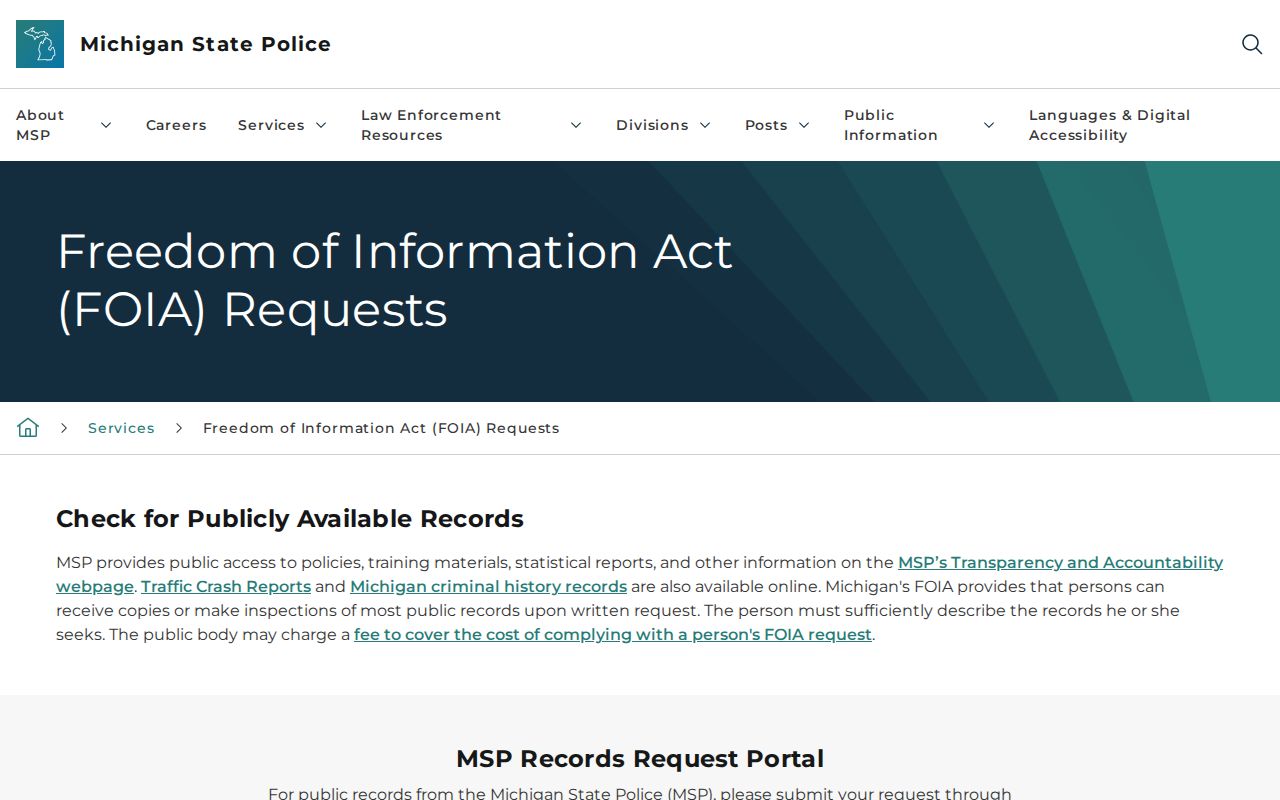
The page helps separate state-agency requests from Midland County and city records channels.
The sheriff's written request should describe the record well enough to locate it. Include the date or range, incident location, involved party, and specific material sought if the report number is unknown. Ask for an electronic copy when practical. Michigan FOIA generally requires an agency response within five business days and permits a ten-business-day extension notice. That clock governs the response, not the date a large or heavily redacted production must be finished. Permitted labor, review, copying, mailing, and redaction charges may apply.
Midland Police has a separate city FOIA path even though its Records Bureau shares the Law Enforcement Center lobby with the sheriff. The city routinely provides traffic crash reports, domestic-violence reports to victims, and limited burglary, larceny, or vandalism summaries through its published process; other records use FOIA. Coleman Police has no verified dedicated portal or fee table, so call its nonemergency line to identify the custodian and route a written request through Coleman City Hall. Do not borrow Midland City's form or fees for a Coleman event. For every agency, ask for the narrow record actually needed instead of requesting an undefined file.
Public release does not mean each part of an arrest file is open. An active investigation, protected victim identity, medical detail, juvenile information, or material whose disclosure would interfere with enforcement can be withheld or redacted. A denial should state the legal basis and appeal rights. If the goal is only to learn the filed charge and outcome, the court register may be faster and less restricted than seeking the full police narrative. If the goal is to understand the officer's account, the docket alone will not supply it.
Inside a Midland County Arrest Record
Midland County arrest records are organized by the event and intake, not by the final court judgment. Fields may be split between the investigating agency and the jail roster. Public release also depends on Michigan law, agency policy, the stage of the investigation, and privacy restrictions. No names or booking photographs are republished here.
| Booking identifier | Distinguishes one Midland County Jail intake from another event involving the same person. |
|---|---|
| Booking date and time | Shows when the jail processed the person, which may differ from the arrest time. |
| Arresting agency | Identifies the office most likely to hold the incident and arrest narrative. |
| Charges as booked | Lists allegations entered at intake; prosecutor-authorized counts may later differ. |
| Bond and court | May show bond type or amount and the court assigned to the first appearance. |
| Fingerprints and photograph | Created during intake; public release of a booking image depends on law and agency policy. |
| Custody or release | Shows current status where the official roster provides it; release does not state the case outcome. |
The officer's legal and probable-cause narrative may appear only in the agency report, while the jail entry focuses on custody processing. Fingerprints and a photograph are intake products. Bond may change at arraignment, and the court can enter a later warrant or release condition. The prosecutor-authorized charge is often the most important difference: it can depart from the offense label used by the arresting officer. For a complete Midland County result, pair the booking fields with the chronological register of actions.
The register of actions can add the case number, filing date, public parties, judge, attorneys, hearing dates, disposition by count, sentence, and post-judgment events. It may list a document without offering a free download. In that case, contact the clerk with the case number, document title, and date, and ask whether the record is onsite, archived, paper only, or available as a copy. Protected identifiers, victim information, juvenile matters, and restricted cases will not appear as ordinary public data.
Midland County Arrest Custody Tools
The current roster answers a local jail question. The Michigan Department of Corrections Offender Tracking Information System, or OTIS, covers current prisoners, parolees, MDOC probationers, and many people discharged within three years. It excludes people held only in a county jail or city lockup and those sentenced only to jail. The federal Bureau of Prisons locator is a third, separate system.
The official OTIS search is shown below. Use it after Midland County custody ends only when the case entered MDOC imprisonment or qualifying felony supervision.
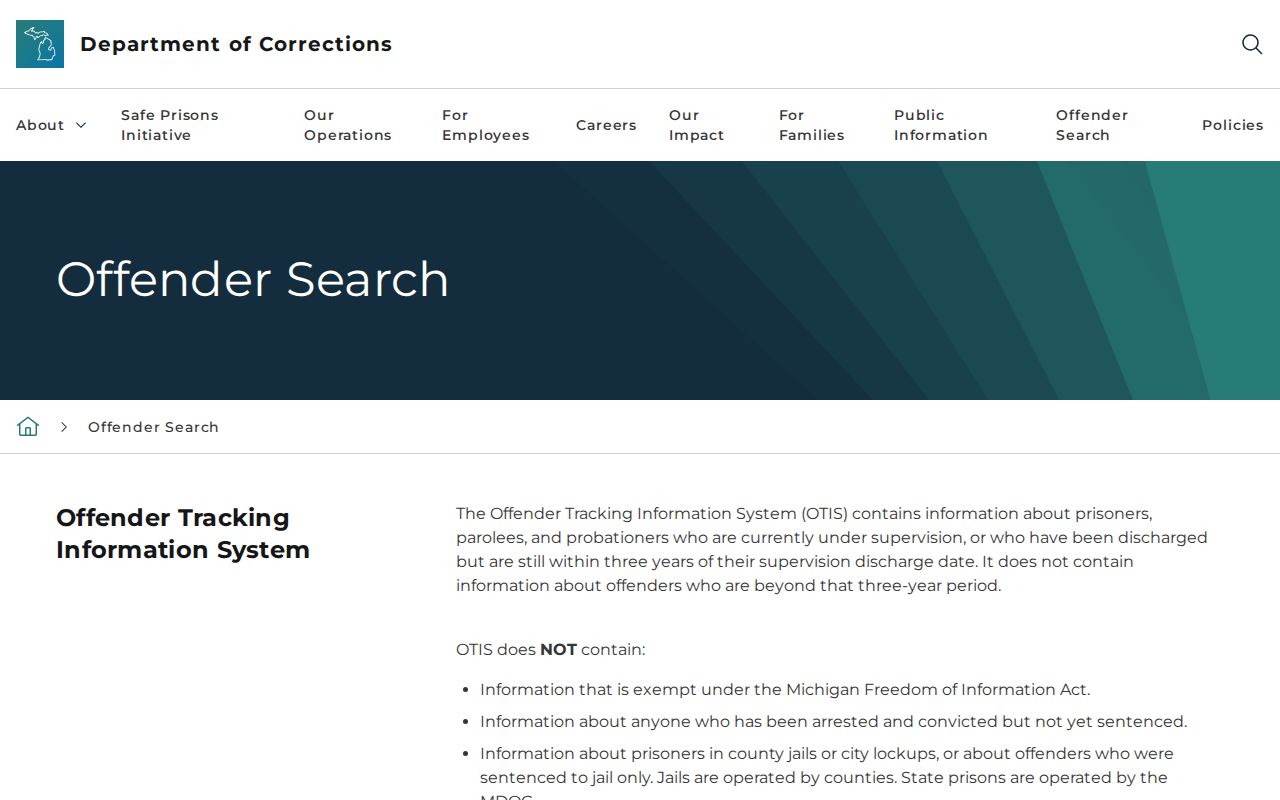
OTIS cannot fill gaps in the Midland County roster because the two systems cover different custody populations.
Federal custody likewise requires the Bureau of Prisons inmate locator, pictured here.
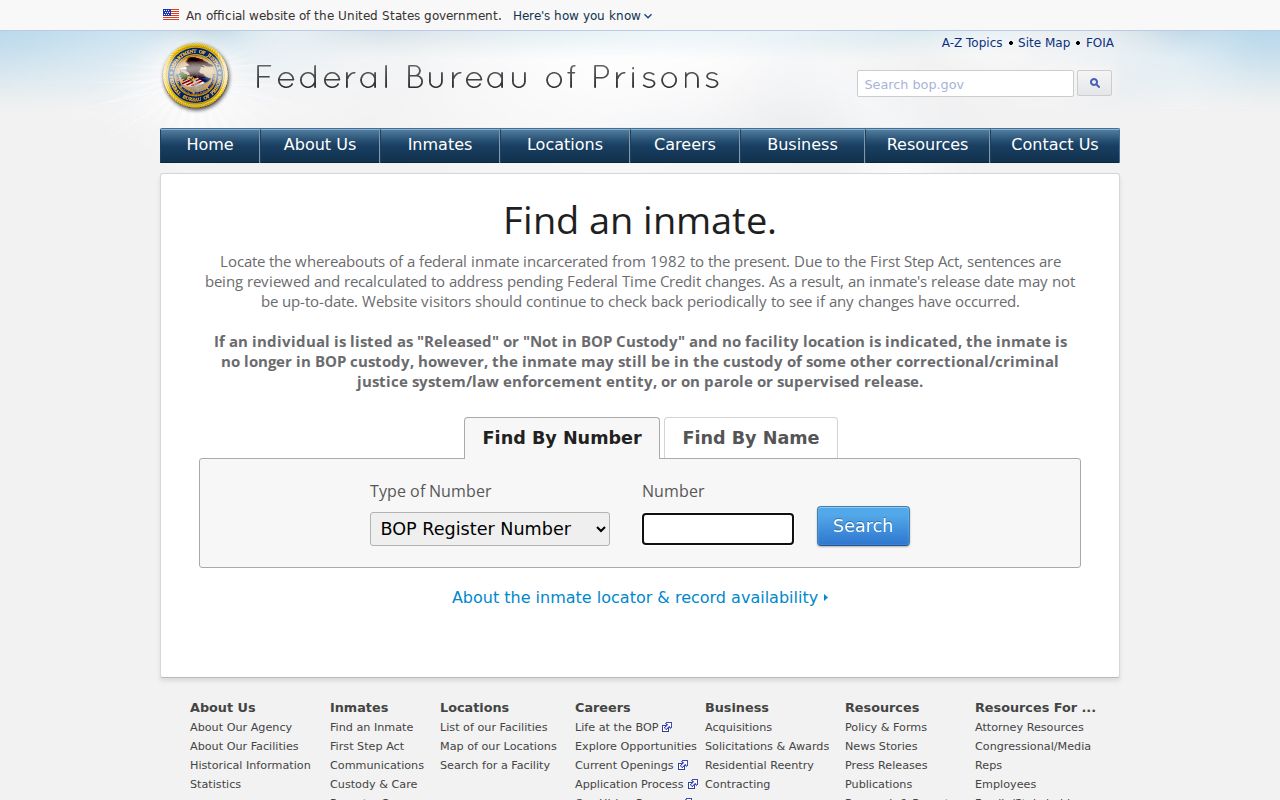
A federal result does not replace the local arrest report or Midland County court trail.
Choose the locator by custody authority. Use the Midland County roster for current local detention and pretrial custody. Use OTIS for MDOC prison, parole, and qualifying felony probation records, while noting its discharge and population limits. Use the federal locator only for Bureau of Prisons custody. MI-VINE can provide custody and release notifications, but it is a notice service rather than the official case, arrest, or booking record. A search across all three without that distinction can create false gaps.
Booking Logs and Recent Arrests
Midland County has no separately verified official booking blotter. The only confirmed recent-custody publication is the Inmate Roster linked from the county jail page. The Sheriff mobile app through MyOCV also advertises current inmate information and can be useful when the vendor-hosted roster is hard to reach on a phone. The app also provides alerts, emergency updates, anonymous tips, service links, and office news, but the official page does not claim a warrant search or records-request module.
A missing roster entry does not prove that no Midland County arrest occurred. The person may have been released, cited without jail booking, transferred, handled as a juvenile, listed under a different spelling, or affected by a data lag. Call Jail Records for very recent custody. Then search the D75 docket and request the arrest narrative from the investigating office. Current custody, filed charges, and a final judgment are three different questions.
The roster should be read only for fields it actually displays. The county research verified a current-custody list and profile navigation, but did not retain a private sample record or confirm every vendor field. Look for the booking identifier and date, charges as booked, bond, arresting agency, and custody status when shown. Do not infer missing details. The live vendor link may change, which is why the official jail gateway, Sheriff app, and Jail Records phone line are the safer entry points.
Very recent events may not yet have a court filing. After release, the roster may no longer answer the question even though the agency report and later docket still exist. Wait for ordinary filing time, then search the 75th District Court by the most complete legal name and compare the event facts. If the arrest was outside the city limits, do not assume Midland Police investigated. The sheriff, Coleman Police, MSP, or DNR may be the correct report custodian.
Midland County Booking at Fast Ice
The Midland County Jail is at 101 Fast Ice Drive, separate from the sheriff's administrative and road-records counter on Rodd Street. Its 274-bed podular design includes open intake and pods for trustees, work release, women, maximum security, medium security, and direct supervision. Jail Records handles inmate statistics, visitor check-in, work release, billing, reception calls, and custody inquiries.
That split can trip up an arrest search. Ask the Records Bureau for a completed sheriff incident report, but use the jail roster or 989-832-6612 for current Midland County custody. The Sheriff app also exposes current inmate information. Neither the facility layout nor the roster states whether an allegation was proved. The 75th District Court docket remains the next source for filed charges and bond entries.
Midland County Arrest Fingerprints
For a recordable arrest, fingerprints and charge data move from the arresting agency toward MSP's Criminal Justice Information Center. Courts and police later report dispositions. Timing or correction issues can make the statewide history appear different from a current Midland County booking or court register. ICHAT provides a $10 name-based public Michigan product, but it excludes warrants and is not an identity guarantee.
A person reviewing their own full Michigan record can use MSP's fingerprint personal-review process. It carries a $30 state processing fee and generally takes three to five weeks including mail. The official fingerprint review and correction instructions appear below.
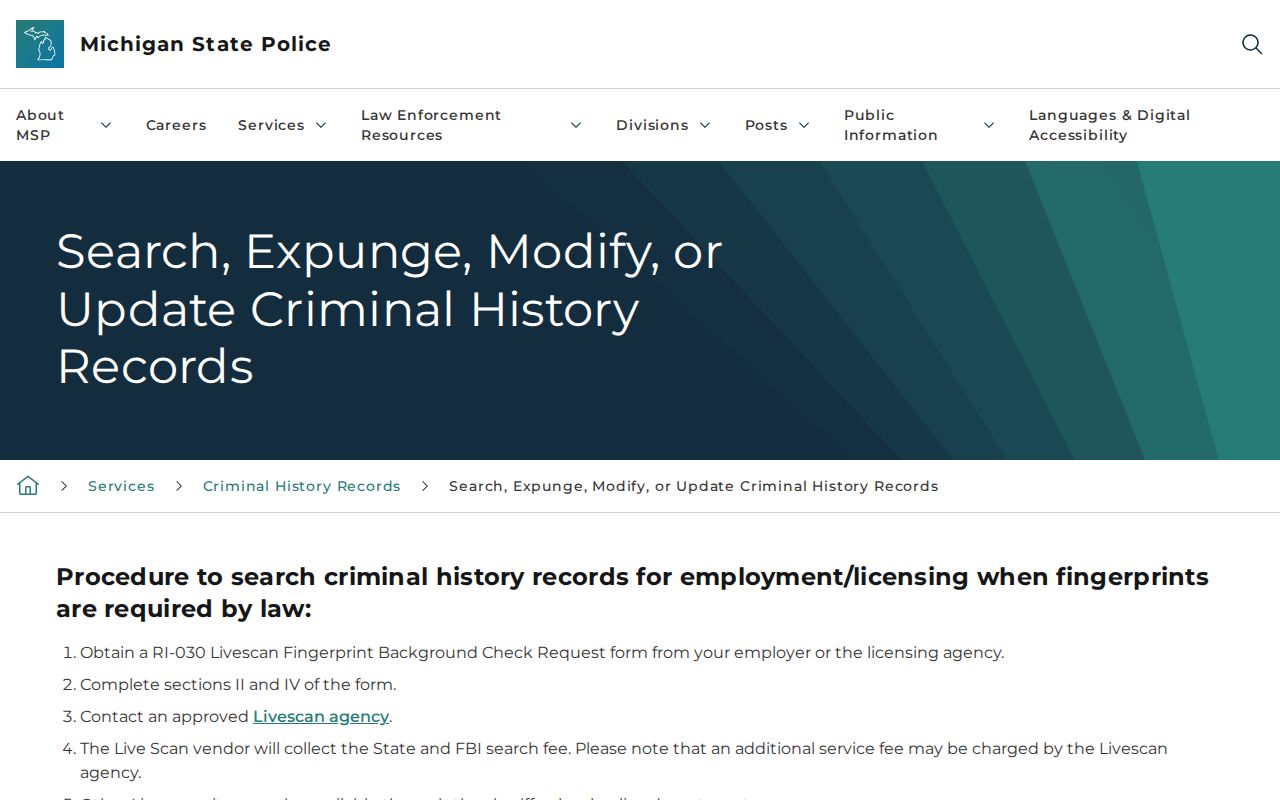
Certified disposition records from the correct court support a request to fix an inaccurate Michigan entry.
For the subject's national identity history, the FBI electronic ordering portal uses fingerprints and an $18 federal fee.
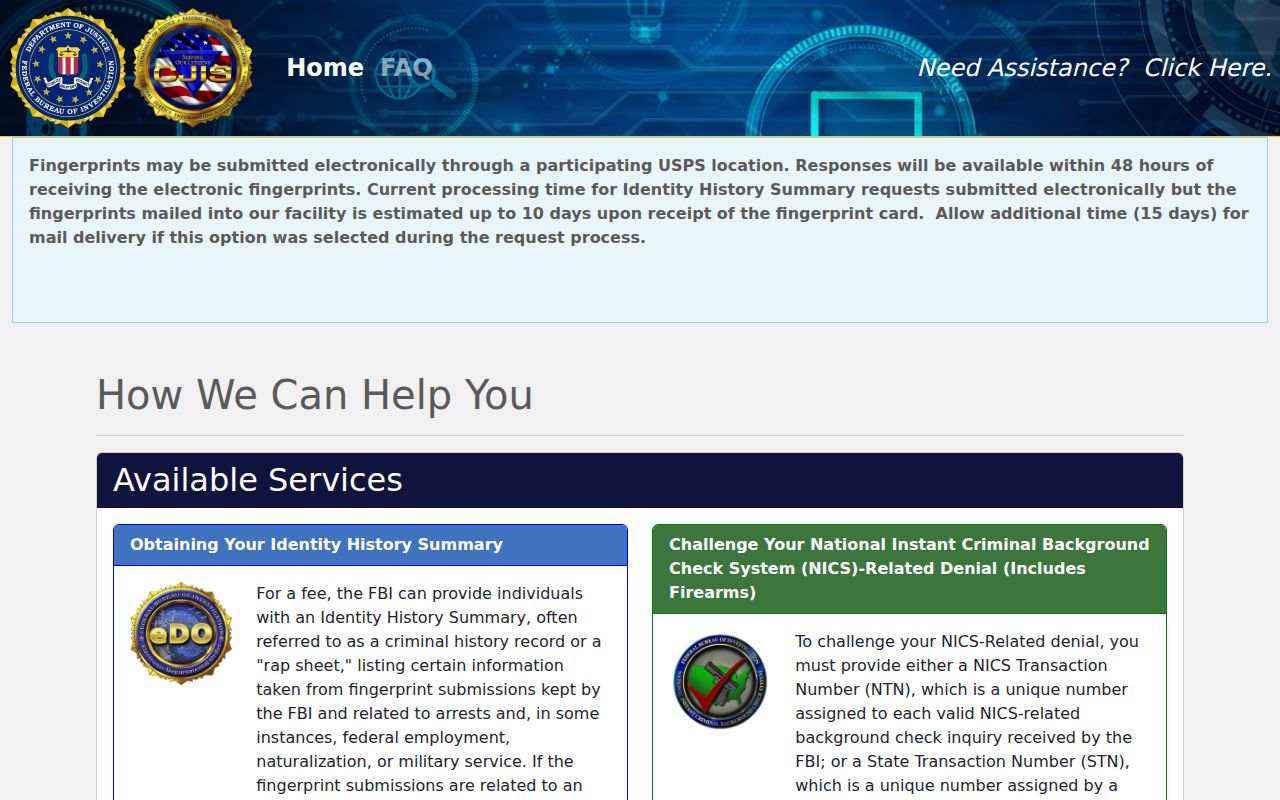
The FBI product is subject-only and does not substitute for a Midland County incident report or case file.
Midland County Sheriff provides both ink-card and Live Scan capture, but its published window is limited to the second and fourth Wednesday from 9:00 to 11:00 a.m., first come and first served. Photo identification is required. Ink cards cost $15 and Live Scan costs $61.50. A person must know whether a state or federal card is needed and should bring the required request form for Live Scan. Those charges cover local fingerprint services; the repository or FBI product can have a separate fee.
Arrests Are Not Convictions
A Midland County arrest record shows that an officer and jail took specific action based on allegations. A conviction record shows that a court entered a judgment of guilt. Between those points, a prosecutor may decline a count, amend it, or file a different charge. A judge or jury may dismiss or acquit. The full outcome belongs in the Midland County criminal court case file, not in the booking label alone.
| Arrest Record | Conviction Record |
|---|---|
| Created by the arresting agency and Midland County Jail. | Created by the 75th District or 42nd Circuit Court. |
| Proves an arrest or booking event was recorded. | Proves the court entered a finding of guilt. |
| Lives in agency files, jail records, and qualifying CJIC reporting. | Lives in the court file and reported state history. |
| May lead to release, no filed case, dismissal, acquittal, or conviction. | May lead to sentence, appeal, correction, or a qualifying set-aside. |
Note: An arrest is not proof of guilt, and Midland County booking charges may never become the charges filed in court.
A dismissal or acquittal does not always make every earlier Midland County record vanish. Agency reports, booking entries, court registers, and state repository history follow different correction and set-aside rules. Michigan law provides procedures for eligible set-asides and for fixing inaccurate state history. A person challenging an entry should obtain the certified disposition from the court responsible for the case, then follow the custodian's correction process. A screenshot of a roster or search result is not a substitute for that certified record.
Michigan's automatic and application-based set-aside rules can make qualifying convictions nonpublic for ordinary searches, but they do not mean each historical government record was physically destroyed. Arrest fingerprint destruction and repository changes also depend on the law and case result. When an automatic set-aside seems missing, check both the court record and ICHAT, then contact the court of conviction and MSP with certified documentation. The correction path should match the source of the error instead of relying on one portal to update every other system.