
Checking Criminal History in Midland County
No one database holds a complete Midland County criminal history. Begin with MiCOURT Case Search because every county prosecution starts in District Court. The District Court finishes misdemeanors and conducts the first felony hearings. A felony that is bound over then has a Circuit Court file. Match a result by full legal name, filing facts, and any known case number. A shared name alone is weak proof.
The next source depends on the missing fact. The investigating agency holds its incident narrative. The Midland County Jail holds current booking and custody data. Michigan State Police compiles the statewide public history product, while MDOC tracks its prison, parole, and qualifying probation population. Use this order:
- Select Midland’s District Court in MiCOURT and search by case number or full name.
- Read the register of actions for charges, hearings, disposition, and sentence.
- Check Circuit Court too when the felony docket shows a bindover.
- Ask the arresting agency or jail for the report or custody facts that the court file does not contain.
- Use ICHAT or fingerprint review for the right official state-level product.
Four Midland County Record Systems
Four official channels answer four different questions. MiCOURT explains a filed case. ICHAT returns a public Michigan criminal-history subset from CJIC. The county Inmate Roster answers whether someone is in local custody now. OTIS covers current MDOC prisoners, parolees, MDOC probationers, and many people discharged from supervision within three years. It excludes a person held only in the Midland County Jail.
| Channel | Best question | Main limit |
|---|---|---|
| MiCOURT | What was filed and how did the case end? | Participating-court data and documents vary |
| ICHAT | What public Michigan history did CJIC return? | Name based and not a complete personal record |
| Inmate Roster | Is the person in Midland County custody now? | Not a full arrest or conviction history |
| OTIS | Is the person under qualifying MDOC custody or supervision? | Omits county-jail-only records |
These systems may differ without any one of them being wrong. Each captures a different stage and custodian.
Michigan Official Background Checks
The Michigan State Police Criminal History Records program offers ICHAT for public, name-based searches. ICHAT requires first name, last name, gender, and date of birth, then charges $10 at checkout. It can include public Michigan felony arrest and conviction material plus qualifying serious-misdemeanor convictions held by CJIC. It does not promise warrants, federal, tribal, juvenile, traffic, out-of-state, or all lesser local misdemeanor records.
The official MSP service hub shows where statewide history differs from a Midland County case file. The MSP criminal-history page is shown here:
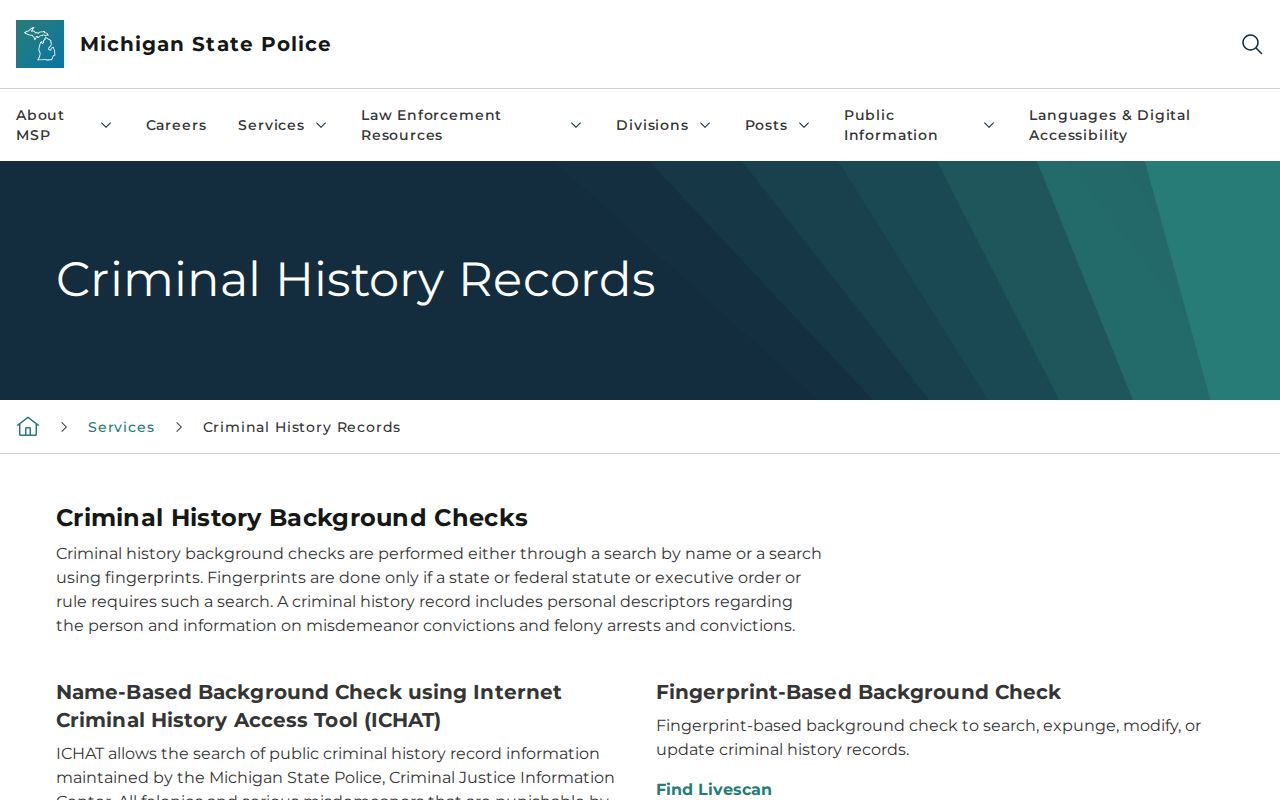
Use the state product for its stated scope, then return to the Midland court record for the filed counts and judicial outcome.
Midland County Fingerprint Wednesdays
A fingerprint match is the stronger route for reviewing one’s own Michigan record. MSP accepts a mailed fingerprint card with a cover letter, return details, and a $30 check or money order payable to the State of Michigan. The response includes public and nonpublic Michigan information tied to the prints. MSP estimates about three to five weeks including mail and includes one certified or notarized original; extra originals cost $1 each.
The Midland County Sheriff captures prints at the Law Enforcement Center, 2727 Rodd Street, only on the second and fourth Wednesday from 9:00 to 11:00 a.m. Service is first come, first served, and photo identification is required. Ink cards cost $15. Live Scan costs $61.50, and the applicant must bring the required request form. The fee and identity method change what the service provides.
| Official service | Base fee | Method |
|---|---|---|
| ICHAT | $10 | Name, gender, date of birth |
| MSP personal review | $30 | Fingerprint card |
| Sheriff ink card | $15 | Local capture service |
| Sheriff Live Scan | $61.50 | Electronic prints |
| FBI Identity History Summary | $18 FBI fee | Fingerprints |
Criminal Record Types
Midland County criminal records are built in stages. An officer’s incident report describes the event, evidence, and allegations. The jail’s booking entry records intake, custody, booked charges, and bond. The prosecutor decides which charges to authorize. The court file then records the complaint, arraignment, hearings, outcome, and sentence. A state history entry depends on fingerprint and disposition reporting to CJIC.
- Agency report: the sheriff, city police, MSP, or DNR keeps the narrative it created.
- Booking record: the county jail tracks intake and current custody, not guilt.
- Court file: District and Circuit Court registers show what prosecutors filed and what judges did.
- Warrant record: the issuing court controls the judicial order and related docket.
- Corrections record: OTIS shows a narrower MDOC custody or supervision population.
Probation and parole records also split by office. District Court Probation handles misdemeanor supervision and can be reached at 989-832-6710. MDOC Field Operations handles felony probation and parole, with Midland routing through 220 W. Ellsworth Street and 989-832-6760. The Michigan Parole Board is the state paroling authority. A court judgment states the sentence, while OTIS may show the current qualifying supervision status.
Midland County Open Warrants
The 75th District Court Open Warrants page is the county’s confirmed public warrant channel. It is updated periodically and covers current open warrants only in that court’s Traffic and Criminal departments. It is not a real-time statewide list, and it does not cover sealed, juvenile, or every other court warrant.
If a name appears, call the Criminal Department at 989-832-6702 or 989-832-6718 to ask about arraignment. Search the related MiCOURT case and confirm the case number directly. Do not pay an unsolicited caller. Midland Police warned that officers do not demand warrant payments by phone or Bitcoin. A court-issued bench warrant, an arrest warrant, and a search warrant serve different roles, so the case docket and court are the safest sources for what the entry means.
Inside a Midland County Criminal Record
A Midland County criminal record must be read in context. An MSP fingerprint record is organized by identity and arrest cycles. A court file is organized by case number. A booking entry is organized by intake. Differences in charges or dates can reflect normal movement from arrest through prosecution rather than an error.
| Name & Identifiers | Legal name, aliases, date of birth, and identifying details, with public display limits. |
|---|---|
| Arrest / Booking Data | Agency, booking date, alleged offenses, bond, and custody or release status. |
| Charges & Statutes | Filed count descriptions and Michigan law citations in the court register. |
| Disposition | Conviction, dismissal, acquittal, or another outcome for each count. |
| Sentence | Jail or prison, probation, costs, restitution, and post-judgment events when public. |
| Custody / Supervision | County custody belongs to the roster; qualifying state status may appear in OTIS. |
A status word should be read with its source. “Booked” reports jail intake. “Bound over” shows that a felony passed from District Court toward Circuit Court. “Dismissed” means that count ended without conviction, but it does not by itself erase every agency or booking record. “Set aside” means a qualifying Michigan conviction became nonpublic for ordinary purposes under the governing relief process.
Midland County Records Use Three Buildings
The desired record controls where to call or visit. Court files are at the Midland County Courthouse, 301 W. Main Street. Sheriff road reports and fingerprint services are at the Law Enforcement Center, 2727 Rodd Street. Current custody and inmate inquiries point to Midland County Jail, 101 Fast Ice Drive. The jail has 274 beds and separate operational pods, while its records staff handles the custody side of the system.
Trial Courts
301 W. Main Street
District Court: 989-832-6700
Circuit Clerk: 989-832-6735
Sheriff Records Bureau
2727 Rodd Street
989-839-4630
Monday-Friday, 8:00 a.m.-5:00 p.m.
Courthouse visitors pass through Sheriff Court Security screening. Public access to a file does not create a right to use a phone or record a hearing inside the courtroom.
Public Access Laws in Michigan
Michigan law separates agency records from judicial files. Ask the sheriff or city police for an incident report under Michigan FOIA. Inspect a court record through MiCOURT or the clerk under Michigan Court Rule 8.119 because the judiciary is not a FOIA public body. Use ICHAT or MSP fingerprint review for repository information. Active investigations, private data, juvenile material, victim details, and restricted cases may not be public.
Key access rules:
MCL 15.231 states Michigan’s policy favoring access to nonexempt public records.
MCL 15.233 provides the right to inspect or copy qualifying agency records.
MCL 15.235 sets agency response and denial procedures.
MCL 15.243 lists exemptions that can support withholding or redaction.
MCR 8.119 governs inspection of public Michigan court records.
Midland County Sheriff Report Requests
The Sheriff Records Bureau keeps completed incident and crash reports, criminal complaints, local file checks, and other road records. Use the official Midland County NextRequest portal for a written sheriff report request. Include the incident number when known. Otherwise give the date or range, location, involved party, investigating deputy if known, and the exact report, supplement, audio, photo, or video sought.
Ask for an electronic copy when that may cut duplication cost. Michigan FOIA permits certain labor, search, review, redaction, copying, and mailing charges. The normal agency response clock is five business days, with a permitted ten-business-day extension notice. That deadline governs the response, not the completion date for a large record production. A $10 sheriff file check is a local service and is not the same product as a $10 ICHAT report.
Sealed, Expunged, and Restricted Records
Michigan calls conviction relief a set-aside, while public guidance also uses expungement. A qualifying set-aside makes the conviction nonpublic for ordinary searches, but it does not mean every historical record is physically destroyed. Juvenile files, protected victim data, and nonpublic repository details follow separate rules.
Application-based relief is filed in the court of conviction. The package generally includes the SCAO application, certified case material, fingerprints, service on required parties, and the $50 MSP processing fee. Waiting periods and offense limits depend on the convictions. Michigan Clean Slate also provides automatic set-asides for certain qualifying cases after statutory periods.
The MSP Clean Slate record-review comparison shows the official public and fingerprint review choices:
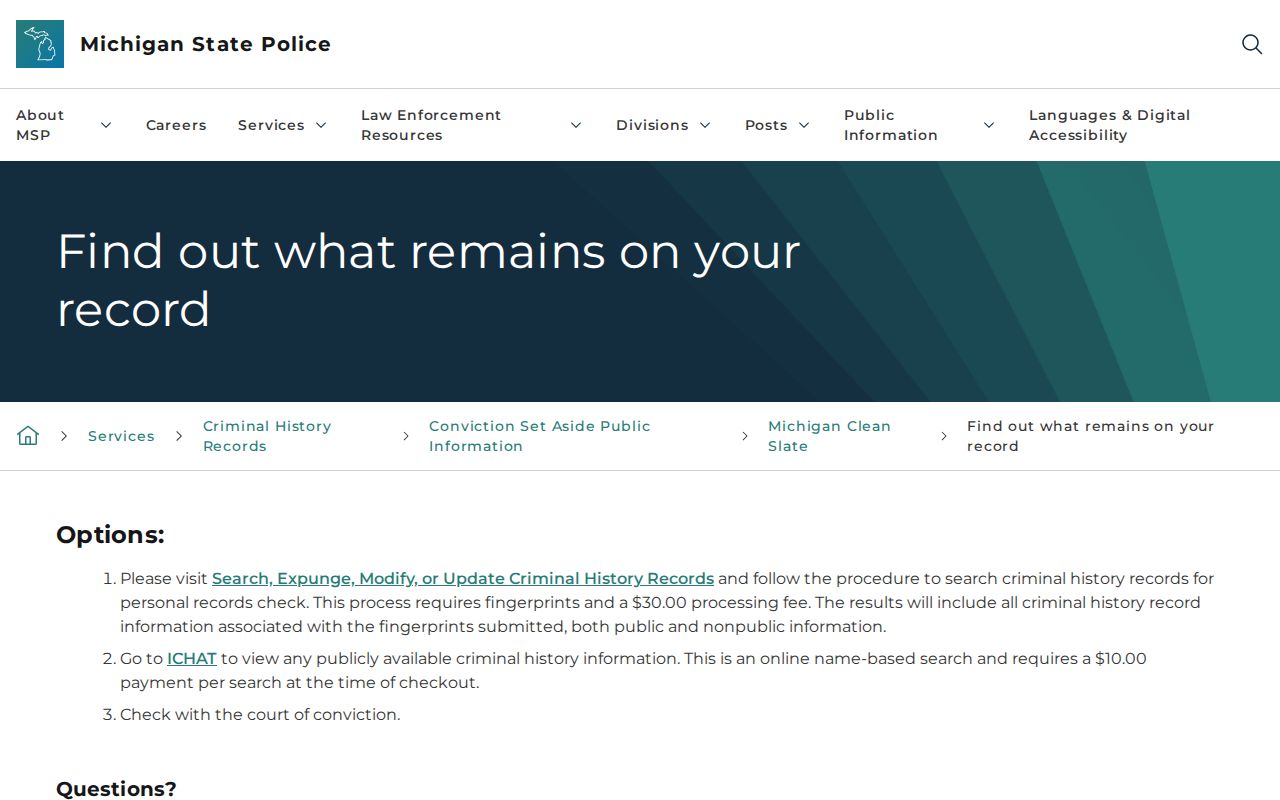
After relief, check the court record and ICHAT. Use the fingerprint personal-review route when a more complete self-check is needed.
Midland County Custody Records
Current county custody begins at the official jail page’s “View the current Inmate Roster” link. If the vendor link fails, call Jail Records at 989-832-6612. The Sheriff mobile app also advertises current-inmate information, alerts, tips, key services, and office news through MyOCV. The app does not advertise a warrant-search feature, so it should not be treated as one.
OTIS is the state corrections layer. It can show an MDOC number, status, supervision office, sentence offenses, dates, photograph, aliases, and marks when available. It excludes county-jail-only people and jail-only sentences. Federal custody is separate again and belongs in the Bureau of Prisons locator. Choosing the right custody tier prevents a blank search from being mistaken for proof that no record exists.
Midland County Specialty Court Records
The Circuit Court links Recovery Court, Mental Health Court, and MiHOPE. Midland County also operates Community Corrections through a Public Act 511 advisory board whose membership spans courts, sheriff, police, prosecution, defense, government, business, and the public. These programs can shape conditions, supervision, and later docket entries, but the register of actions remains the place to confirm what the court ordered in a specific case.
The county reported its 100th and 101st Recovery Court graduates in June 2026. That milestone gives local context to case outcomes that may involve treatment and close court oversight instead of a simple one-line sentence. Program participation should never be assumed from a charge alone. Read the docket and obtain the relevant public order from the clerk.
Supervision records also split by sentence. Midland County District Court Probation handles misdemeanor presentence work, assessments, supervision, and violation hearings. MDOC Field Operations handles felony probation and parole from its Midland office. OTIS may show qualifying MDOC status, but it excludes district misdemeanor probation and people sentenced only to county jail. A court judgment identifies the sentence; the correct probation office confirms current local supervision details.
Midland County Criminal Records by City
Midland County has two incorporated cities. Midland Police and Coleman Police create their own reports, but neither city has a municipal court or city jail. Criminal cases begin in county District Court, and current custody uses the county jail. Start with the investigating city agency for its narrative, then follow the case into MiCOURT.
Midland Criminal Records
42,806 estimated residents · City police records and FOIA route
Coleman Criminal Records
1,243 residents · Police contact with City Hall FOIA fallback
Midland Police and the county sheriff share the Law Enforcement Center at 2727 Rodd Street, yet they keep separate records and use separate request routes. Coleman Police has no published dedicated records portal, so callers should identify the police custodian at 989-465-1711 before sending a descriptive request through Coleman City Hall. That agency check prevents a request from going to the wrong desk.